
215 Card: How to Get Yours at Cannavine in San Francisco
A 215 card isn't a card you carry—it's your medical marijuana recommendation under Proposition 215. In California, you don't need a state-issued ID card to shop at dispensaries; your doctor's recommendation is enough. At Cannavine, we accept valid recommendations for medical patients 18+.
Do You Qualify for a 215 Card? Conditions and Requirements
In California, a 215 card is your medical cannabis recommendation from a licensed physician. You qualify if you have a condition that a doctor believes could benefit from cannabis, and you're 18 or older (or a minor with a caregiver's consent).
A good fit if…
- You have a qualifying condition – Common ones include chronic pain, anxiety, PTSD, cancer, epilepsy, glaucoma, and nausea. The list is broad, and doctors evaluate on a case-by-case basis.
- You're under 21 but 18+ – Medical patients 18+ with a recommendation can shop at dispensaries like Cannavine.
- You want legal protection – A recommendation gives you legal status under state law, though federal law still prohibits cannabis.
Consider another option if…
- You're 21+ and don't have a medical condition – Adult-use cannabis is legal, so you don't need a card to buy.
- You're seeking federal protection – No state card protects you from federal enforcement.
To decide, ask yourself: Do you have a condition that might benefit from cannabis? If yes, a 215 card could be right. If you're just curious about recreational use, you can skip it.
What Is a 215 Card and Is It Still Valid in California?
Despite the name, a 215 card isn't a physical ID card. It refers to your medical cannabis recommendation under Proposition 215, passed in 1996. This law allows patients with a doctor's recommendation to possess and cultivate cannabis for personal medical use.
After Proposition 64 passed in 2016, adult-use cannabis became legal, but Proposition 215 still exists. You don't need a state-issued Medical Marijuana Identification Card (MMIC) to buy at dispensaries—your recommendation is enough. The MMIC is optional, offered by the California Department of Public Health through county health departments, and can provide extra legal protection.
So, yes, a 215 card is still valid. It identifies you as a qualified patient, and at Cannavine, we accept valid recommendations for medical patients 18+.
215 Card and Police: Your Rights and What Officers See
If you have a 215 card (recommendation), you're protected under state law, but police may still ask questions. During a traffic stop, officers can see your license plate and vehicle registration, but they don't see if you're a medical cannabis patient—that's private medical information.
If you have cannabis in your car, keep it in a sealed container and your recommendation handy. Police can open your car door if they have probable cause, but you have the right to remain silent and refuse a search. Recording police is legal in California, but officers may tell you to stop—you don't have to.
Your 215 card doesn't prevent all encounters, but it provides a legal defense if you're within possession limits.
How to Get Your 215 Card: Step-by-Step Process
- Get evaluated – Schedule an online appointment with a licensed physician. Many services, like NuggMD, offer evaluations in minutes.
- Receive your recommendation – If approved, you'll get a PDF or digital copy. You can use this immediately.
- Optional: Apply for MMIC – Visit your county health department to get a state ID card. This is voluntary but can add protection.
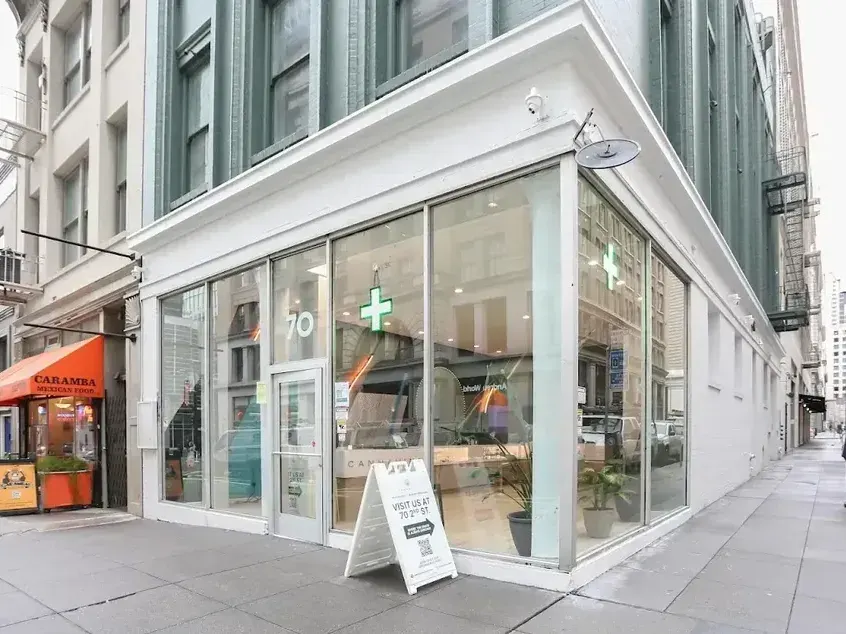
- Shop at Cannavine – Bring your recommendation and a government-issued ID (for 18+). We're at 70 2nd St, San Francisco. Order ahead for pickup, usually ready in 20 minutes.
1996 California Proposition 215
Proposition 215, also known as the Compassionate Use Act of 1996, is a California law that legalized medical cannabis for patients with a doctor's recommendation. It was passed by voters in 1996, making California the first state to approve medical marijuana. The law allows patients and their caregivers to possess and cultivate cannabis for personal medical use, despite federal prohibition. Over time, it has been expanded to support collective and cooperative distribution. Today, Proposition 215 remains the foundation of medical cannabis in California, and it's why you can get a recommendation and shop at places like Cannavine.
Directions to our dispensary near SoMa from Museum of Modern Mythology
Start at Museum of Modern Mythology and head to Cannavine Cannabis Dispensary (San Francisco) at 70 2nd St, San Francisco, CA 94105.
215 Card Cost: What You’ll Pay and How to Save
| Factor | Why It Matters | Typical Range |
|---|---|---|
| Evaluation fee | Online services often charge less than in-person clinics. | Varies, often $25–$50 |
| MMIC application | County health departments charge a fee, which may be reduced for low-income patients. | Varies by county |
| Renewal | Recommendations typically last one year. | Similar to initial cost |
To save, compare online providers—they're often the cheapest. At Cannavine, we don't set these fees, but we can guide you to resources.
Use Your 215 Card at Cannavine Dispensary in San Francisco
Ready to use your 215 card? Visit us at Cannavine Cannabis Dispensary in SoMa, just two minutes from Montgomery Street BART/Muni. We're at 70 2nd St, San Francisco, CA 94105. Call (415) 766-4372 for questions.
- Order ahead – Call or order online; pickup is usually ready in 20 minutes.
- Bring your ID – Government-issued photo ID for 21+, or 18+ with a medical recommendation.
- Check in – First visit? Check in at the counter, and a budtender will help you browse.
- Pay – We accept debit and cash; no credit cards.
We're open Sun 10am–7pm, Mon–Fri 9am–8:30pm, Sat 10am–7pm. Street parking is metered; most people walk or ride.



Sources
Also asked as
- What is a 215 card?
- How do I get a 215 card in California?
- Do I need a 215 card to buy medical cannabis?
Frequently asked questions
Does prop 215 still exist?
Yes, Proposition 215 is still in effect. It was expanded by Proposition 64, but the medical cannabis program remains. You can still get a recommendation and shop at dispensaries.
What conditions qualify for a medical card in California?
Qualifying conditions include chronic pain, anxiety, PTSD, cancer, epilepsy, glaucoma, and nausea, among others. Doctors evaluate on a case-by-case basis, so if you think cannabis might help, consult a physician.
When did prop 215 pass in California?
Proposition 215 passed on November 5, 1996, with 55.6% of the vote. It was the first state-level medical marijuana initiative in the U.S.
Can a cop see if you have a medical card?
No, police don't have access to your medical cannabis records during a traffic stop. They can only see your license plate and registration, not your patient status.
Can a cop open your car door during a traffic stop?
Police can open your car door if they have probable cause to search, but you have the right to refuse consent to a search. You can also record the interaction, as it's legal in California.